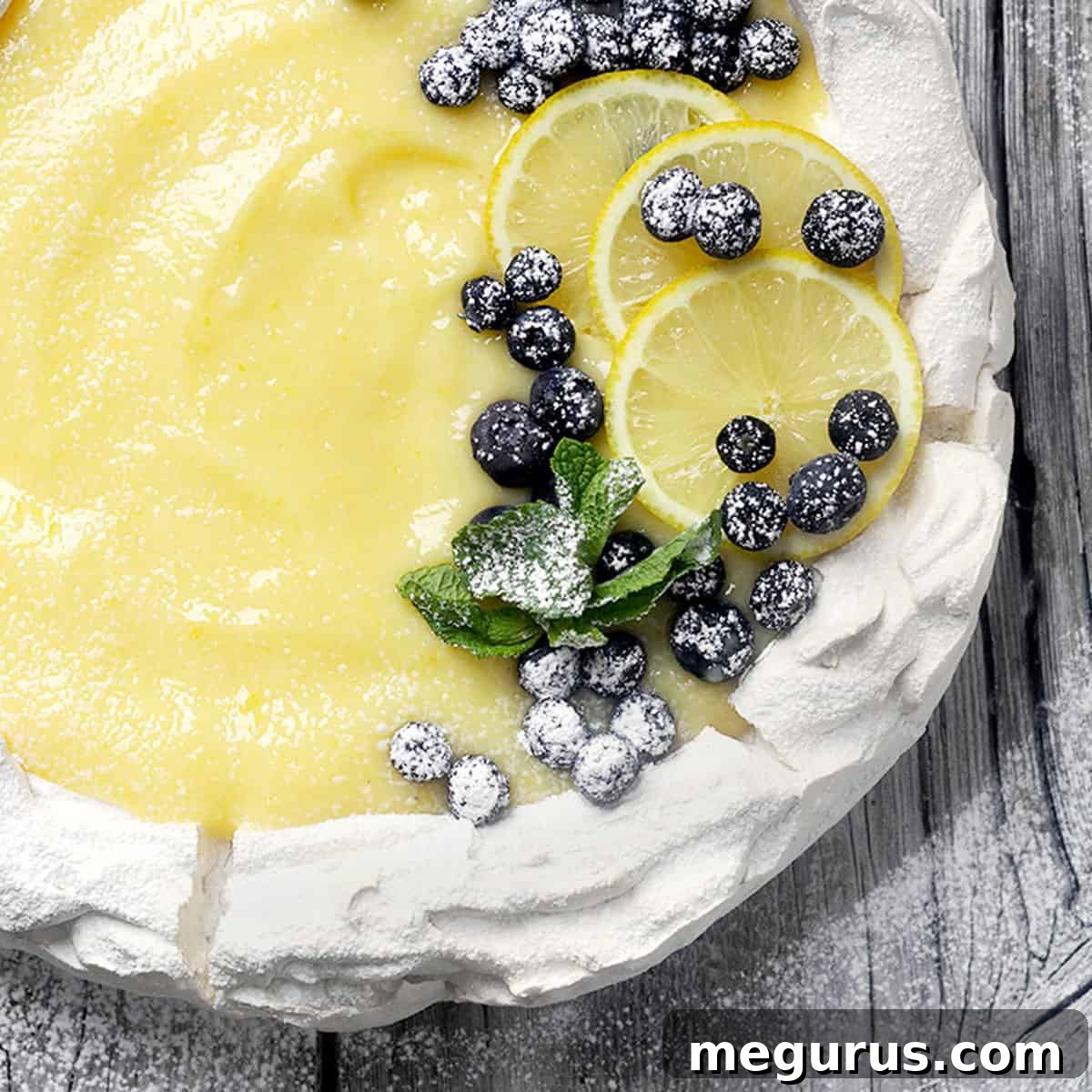
Discover the ultimate showstopper dessert that perfectly captures the essence of spring and the joy of special celebrations like Easter: a glorious Lemon Curd Pavlova. This exquisite creation boasts a heavenly marshmallow-soft center, encased in a delicate, crispy meringue shell, all crowned with a luscious, tangy homemade lemon curd. It’s a harmonious blend of textures and flavors – light, fresh, and irresistibly delicious. Best of all, this impressive dessert can be largely prepared in advance, making your entertaining effortless and enjoyable.
The Irresistible Allure of Lemon for Spring
When the warmer days of spring arrive, my culinary imagination invariably turns to lemon. There’s something inherently uplifting about its bright, vibrant flavors and the cheerful yellow hue that perfectly mirrors the season’s renewal. Lemon desserts, with their refreshing tartness and delightful aroma, are an ideal choice for celebrating spring holidays, especially Easter. This Lemon Curd Pavlova offers an unparalleled way to savor all these qualities, providing a light yet decadent treat that’s sure to impress.
Pavlova, a dessert named after the Russian ballerina Anna Pavlova, is a marvel of simplicity and elegance. Originating from either Australia or New Zealand, its core appeal lies in its unique textural contrast: a dramatically crisp exterior that shatters gently to reveal a soft, chewy, marshmallow-like interior. This delicate meringue base creates a perfect canvas for a myriad of toppings, but few pairings are as divine as a rich, creamy lemon curd. The zesty tang of the lemon curd cuts through the sweetness of the meringue, creating a perfectly balanced flavor profile that is both invigorating and deeply satisfying.
Prepare Ahead for Effortless Entertaining
One of the greatest advantages of this Lemon Curd Pavlova recipe is its make-ahead friendly nature. Both the meringue base and the lemon curd can be prepared days in advance, allowing you to focus on other aspects of your meal when the big day arrives. This flexibility makes it an ideal dessert for Easter Sunday brunch, spring gatherings, or any occasion where you want to minimize last-minute stress without compromising on presentation or taste.
Essential Make-Ahead Tips
- Assembling your pavlova with the lemon curd should always be done just before serving. This ensures the meringue remains perfectly crisp and doesn’t absorb moisture from the curd, which could lead to a soggy base. The final assembly only takes a couple of minutes – simply spread the luscious curd on top and add your chosen garnishes.
- To prepare the pavlova meringue base in advance, bake it off 12 to 24 hours prior to serving. Once fully baked and the oven is turned off, leave the meringue inside the cooling oven until it reaches room temperature. If you need your oven for other dishes, carefully remove the cooled meringue and store it uncovered at room temperature. Alternatively, cover it loosely with a clean tea towel and leave it on your kitchen counter. It is crucial *not* to refrigerate your meringue, as the humidity in the fridge will cause it to “sweat” and become soft and sticky. In exceptionally humid climates, protecting your meringue from moisture is paramount; an airtight container is usually your best defense.
- The homemade lemon curd is remarkably forgiving and can be prepared several days ahead. Once cooled, cover it tightly with plastic wrap directly touching the surface of the curd (to prevent a skin from forming) and refrigerate for up to a week. Its flavors will often deepen and meld beautifully over time.
- The lemon curd featured in this recipe deviates slightly from the traditional, as it incorporates whole eggs instead of just yolks. This method yields a lighter, creamier curd with a wonderfully smooth, almost pudding-like consistency. It’s incredibly versatile and makes an exquisite topping for the airy pavlova. However, if you have a cherished lemon curd recipe you adore, feel free to use it; the goal is simply a delightful lemon layer.
- For an enhanced serving experience, offer additional fresh blueberries or other seasonal berries alongside each slice. While truly perfect on its own, a generous dollop of freshly whipped cream on the side adds an extra layer of indulgence that no one will ever complain about!
5 Expert Tips for Pavlova Perfection
Crafting a perfect pavlova might seem daunting, but with a few key techniques, you can achieve that sought-after crispy shell and luscious, cloud-like interior every time. Here are the secrets to meringue mastery:
- Ensure Your Mixing Bowl is Impeccably Clean: Any trace of grease or fat in your mixing bowl can sabotage your meringue, preventing the egg whites from whipping up properly. Before you begin, thoroughly wash your bowl (preferably glass or metal) and beaters with hot, soapy water, then rinse well and dry completely. You can even wipe them down with a paper towel dampened with lemon juice or white vinegar as an extra precaution.
- Utilize Older Eggs and Separate with Precision: Older eggs tend to have thinner whites, which whip up to a greater volume more easily than very fresh eggs. When separating eggs, exercise extreme caution to ensure not even the tiniest speck of yolk mixes with the whites. Yolk, being mostly fat, will prevent the whites from stiffening. It’s a good practice to separate each egg into a small, separate bowl before adding it to your main mixing bowl, just in case a yolk breaks.
- Separate Eggs Cold, Whip at Room Temperature: Eggs are easier to separate when cold, as the yolks are firmer and less likely to break. However, egg whites whip best and achieve maximum volume when they are at room temperature. After separating your cold eggs, let the whites sit on the counter for at least 30 minutes (or up to an hour) before whipping.
- Choose a Deep, Narrow Bowl for Optimal Whipping: A deep, narrow bowl helps to concentrate the egg whites, allowing your beaters (whether hand-held or a stand mixer’s whisk attachment) to make constant contact with the entire mixture. This efficient aeration is crucial for building the greatest volume and achieving stiff, glossy peaks.
- Dissolve the Sugar Completely for Stability: Gradually adding sugar, one tablespoon at a time, while the mixer is running, is key. The sugar needs to fully dissolve into the egg whites to create a stable, glossy meringue that won’t weep. Using superfine sugar (also known as caster sugar) helps tremendously, as its smaller granules dissolve more quickly. If you only have regular granulated sugar, you can pulse it in a food processor for about a minute to create finer grains, or simply extend your beating time to ensure full dissolution. Test by rubbing a small amount of meringue between your fingers; if it feels grainy, continue beating.
- Don’t Rush the Cooling Process: After baking, turn off your oven and leave the pavlova inside with the door ajar (or completely closed, depending on your oven and desired texture) until it has completely cooled. This gradual cooling prevents thermal shock, which can cause the pavlova to crack excessively or collapse. Patience is a virtue when perfecting pavlova!
Get the Recipe: Lemon Curd Pavlova
A delightful, light, and fresh dessert, featuring a crisp meringue base crowned with a luscious, tangy lemon curd topping. Beautifully garnished with vibrant fresh lemon slices, plump blueberries, aromatic mint leaves, and a delicate dusting of powdered sugar.
Pin This
15 mins
1 hr 30 mins
1 hr 45 mins
8 people
Ingredients
Lemon Curd:
- Zest of one lemon
- 1 1/4 cup white sugar
- 1/2 cup unsalted butter, at room temperature
- 4 large eggs
- 1/2 cup freshly squeezed lemon juice, strained
- Pinch of salt
Pavlova:
- 6 egg whites
- 1 tsp cream of tartar, OR 1/2 tsp salt
- 1 1/3 cups superfine white sugar, OR normal granulated sugar run through a food processor for a minute or so or just use normal granulated sugar and beat longer per instructions
- 1 tsp vanilla extract
- 3 tsp cornstarch
- 1 tsp white vinegar
For Garnish:
- Thin lemon slices
- Fresh blueberries
- Fresh mint leaves
- Powdered sugar, for dusting
Instructions
Lemon Curd:
- Using a vegetable peeler, remove the zest of one lemon in large strips.
- In a large bowl set over a pot of simmering water (creating a double boiler), combine lemon zest strips, sugar, butter, eggs, lemon juice, and salt. Whisk continuously over medium heat until the lemon curd thickens significantly and coats the back of a spoon. This process typically takes 15-20 minutes. Once thickened, discard the lemon zest strips and strain the curd through a fine-mesh sieve into a clean bowl to ensure a silky smooth texture. Cover the surface of the curd directly with plastic wrap to prevent a skin from forming, then refrigerate for up to 1 week.
Pavlova:
- Preheat your oven to 395°F (200°C).
- Lightly spray a baking sheet with cooking spray, then line it with a sheet of parchment paper (the spray helps the parchment adhere). Place the outer ring of an 8-inch springform pan (without the bottom) in the center of the baking sheet to use as a guide. (Alternatively, you can draw an 8-inch circle on the parchment paper.) Set aside.
- Using an electric mixer with a clean, narrow, deep bowl (or a stand mixer fitted with the whisk attachment), beat the egg whites and cream of tartar (or salt) on the highest setting until soft peaks form. A narrow bowl helps achieve maximum volume. Gradually add the sugar, one tablespoon at a time, without stopping the mixer, beating constantly until the mixture is very thick, glossy, and forms stiff peaks. Add the 3 teaspoons of cornstarch with the last tablespoon of sugar. Continue whipping until the sugar is completely dissolved, which may take about 10-12 minutes with superfine sugar, or up to 15 minutes with regular granulated sugar. To test for dissolved sugar, rub a small amount of meringue between two fingers; it should feel smooth, not grainy. Once the sugar is dissolved, gently fold in the vanilla extract and white vinegar with a rubber spatula using a few quick strokes.
- Spoon the meringue mixture inside the 8-inch springform ring on the prepared baking sheet. Using the ring as a guide, shape the meringue into one large, round base. Create a slight indentation or “nest” on top by pushing some of the meringue towards the edges. This raised rim will beautifully hold your lemon curd. Carefully lift the springform pan ring straight up and remove it. Place the baking sheet with the uncooked meringue into the preheated oven.
- IMMEDIATELY REDUCE OVEN TEMPERATURE TO 210°F (100°C).
- Bake the pavlova for 1 1/2 to 2 hours, or until it feels dry and crisp to the touch. You can test for doneness by carefully tasting a small spoonful of meringue from the top – it should not taste eggy. Don’t worry about the small hole created by testing; it will be covered by the topping. Check at 1 1/2 hours, then every 15 minutes thereafter until ready. Once baked, turn off the oven and leave the pavlova inside to cool completely. It’s common for pavlovas to sink or crack slightly during this cooling process, which only adds to their rustic charm.
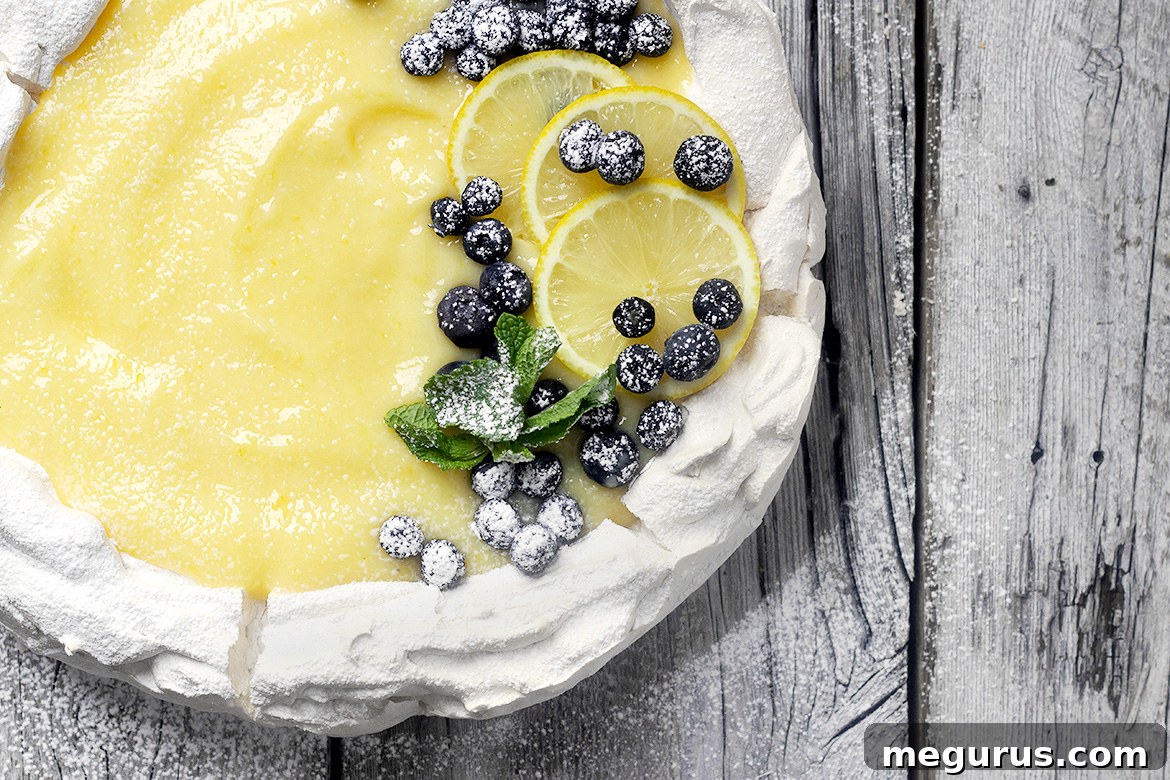
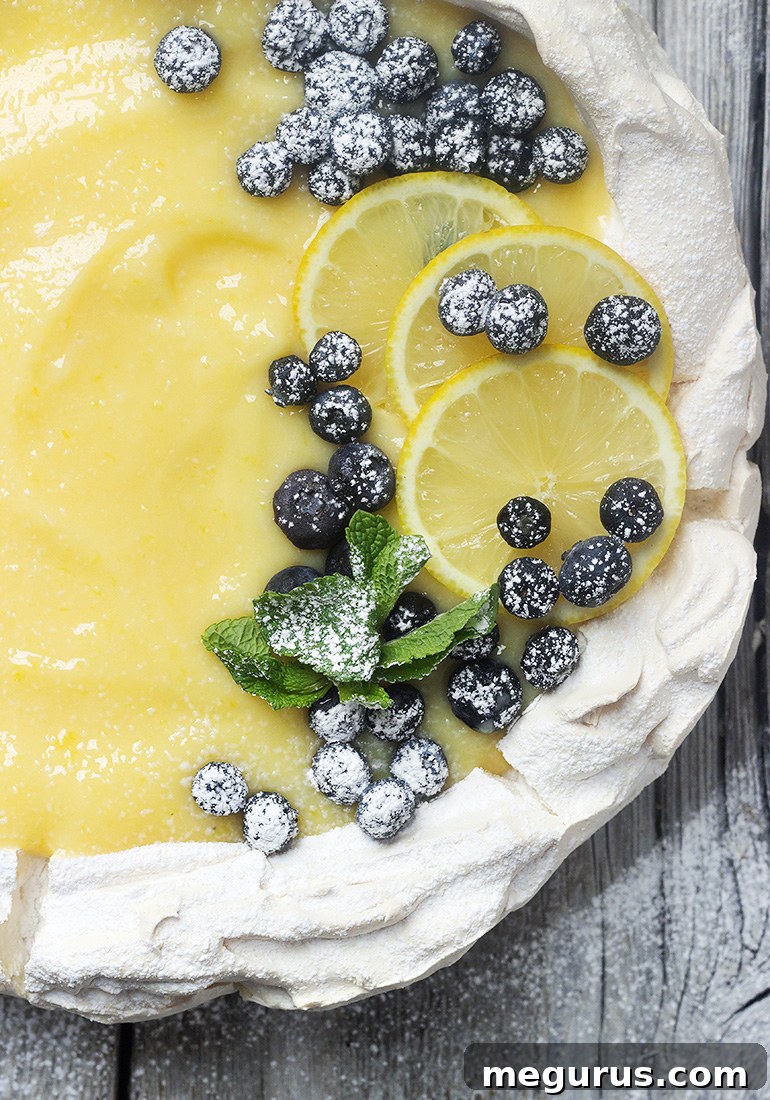
- To Serve: (Remember to add the curd to the meringue just before serving) Spoon the chilled lemon curd generously into the indentation on top of the cooled meringue, spreading it evenly but leaving the outermost crispy edges uncovered. Artfully arrange some thin lemon slices around one side, then scatter fresh blueberries and a few fresh mint leaves over the curd. For an extra touch, dust with powdered sugar, if desired. This dessert is also fantastic served with a dollop of freshly whipped cream on the side.
American, Canadian
Dessert
Jennifer Maloney
Calories: 404 kcal, Carbohydrates: 67 g, Protein: 5 g, Fat: 13 g, Saturated Fat: 7 g, Cholesterol: 112 mg, Sodium: 71 mg, Potassium: 147 mg, Sugar: 65 g, Vitamin A: 475 IU, Vitamin C: 7 mg, Calcium: 21 mg, Iron: 0.5 mg
More Zesty Lemon Recipes to Love!
If you’re enchanted by the bright, refreshing flavors of lemon in this Pavlova, you’ll be thrilled to explore more of our favorite lemon-infused delights. From creamy custards to decadent cheesecakes, these recipes showcase the versatility and charm of this beloved citrus. Perfect for any time of year, they promise to bring a burst of sunshine to your table.